When the lights go out, your home doesn't have to go dark. A reliable standby generator can keep your essential systems humming, but choosing the right size is paramount. This 24kW Generac Generator Sizing Guide for Homes will equip you with the knowledge to determine if Generac's popular 24-kilowatt model is the perfect fit for your household's backup power needs, ensuring you don't overspend or, worse, undersize.
At a Glance: Key Takeaways for Sizing Your 24kW Generac
- It's More Than Just Watts: You need to account for both running watts (continuous power) and starting watts (momentary surge for motor-driven appliances).
- List Your Loads: Create a comprehensive inventory of every appliance and system you want to power during an outage.
- The 24kW Sweet Spot: Often ideal for medium-to-large homes, capable of handling a 4-5 ton AC unit along with other critical systems like refrigerators, lights, and furnaces.
- Don't DIY the Final Call: Always consult a certified Generac dealer for a precise load calculation and professional installation plan.
- Beyond Power: Consider fuel type, transfer switch, installation location, and future needs in your sizing decision.
Why Sizing Matters More Than You Think
Imagine investing in a generator, only for it to sputter and trip circuit breakers the moment your AC unit kicks on. Or, conversely, buying a massive unit that's far more powerful (and expensive) than you'll ever need. Both scenarios represent wasted money and frustration. Correctly sizing your generator isn't just about matching numbers; it's about optimizing performance, efficiency, longevity, and your family's comfort during an emergency.
An accurately sized generator will run more efficiently, conserve fuel, and extend its lifespan. An undersized unit will be constantly overloaded, potentially damaging appliances and shortening the generator's life. An oversized unit wastes fuel and money, running less efficiently at lower loads. This guide focuses on Generac's 24kW model, a powerhouse solution for many modern homes, but its suitability depends entirely on your specific energy footprint.
Is the 24kW Generac the "Goldilocks" Generator for Your Home?
The 24kW Generac Guardian Series generator has become a favorite for homeowners seeking robust, whole-home backup. But what kind of home is it "just right" for?
This model is typically an excellent choice for:
- Medium to Large Homes (2,000 – 5,000+ sq ft): It can comfortably power most or all circuits in a substantial home.
- Homes with Central Air Conditioning: Capable of starting and running a single large (4-5 ton) central AC unit, or multiple smaller ones, alongside other significant loads.
- Families with Specific Needs: If you rely on medical equipment, home offices, multiple refrigerators, or other power-hungry appliances, a 24kW unit provides a healthy margin.
- Desire for Whole-Home Backup: For those who want more than just essential circuits covered, and prefer minimal lifestyle disruption during an outage.
While powerful, it might be overkill for smaller homes with minimal electrical demands or insufficient for exceptionally large estates with multiple high-tonnage AC units, electric vehicle charging, and other substantial loads simultaneously. Understanding your unique situation is the key to making an informed decision. For more general insights into the capabilities of this specific model, you might find Our 24 kW Generac generator guide a helpful resource.
Demystifying Power: Running Watts vs. Starting Watts
Before we dive into calculations, let's clarify two critical concepts:
- Running Watts (Rated Watts/Continuous Watts): This is the continuous power an appliance needs to operate once it's already running. Think of it as the steady demand. Most appliance labels will list this.
- Starting Watts (Surge Watts/Peak Watts): Many motor-driven appliances (refrigerators, freezers, air conditioners, well pumps, washing machines, garage door openers) require a brief, much larger burst of power to start their motors. This surge can be 2-6 times their running wattage, lasting only a few seconds. A generator must be able to handle this momentary surge without tripping.
Why this distinction matters: If your generator can't handle the starting watts of your largest motor, that appliance won't start, or it could trip your generator's breaker. The 24kW rating of your Generac refers to its running wattage capacity, but its ability to handle surge loads is equally important and is often detailed in the generator's specifications.
Step-by-Step: Using the Generac Generator Sizing Guide for Your Home
Generac's approach to sizing is systematic, focusing on ensuring all your desired appliances can run without issue. Here's how to apply their principles.
Step 1: Inventory Your Essentials (and Nice-to-Haves)
Begin by walking through your home, room by room, and making a detailed list of every single item you want to power during an outage. Don't just think "lights"; think which lights, which outlets.
Categorize your list:
- Absolute Essentials: (e.g., refrigerator, freezer, furnace fan, well pump, critical medical devices, minimum lighting, garage door opener, security system, Wi-Fi router).
- High Priority Comfort: (e.g., central AC, water heater, microwave, television, computer workstations).
- Low Priority / Occasional Use: (e.g., toaster, hairdryer, specialty tools, secondary entertainment systems).
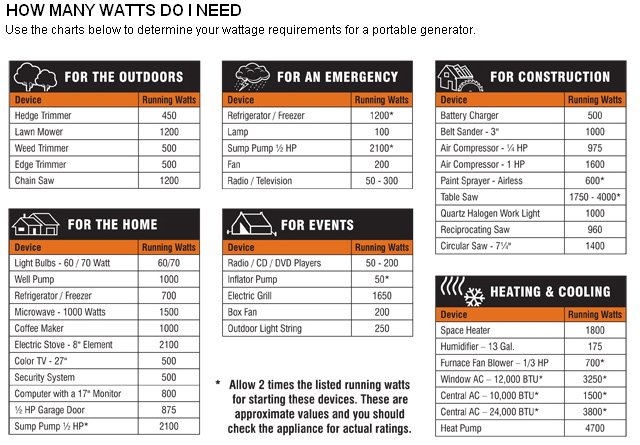
For each item, note its wattage. You can usually find this on a label on the appliance itself, in its owner's manual, or by searching online. If only amperage (A) is listed, multiply Amps x Volts (e.g., 15A x 120V = 1800W) to get wattage. For 240V appliances (like central AC, electric dryer), use 240V.
Step 2: Calculate Your Load (The Worksheet Approach)
This is where the numbers game begins. Generac provides detailed sizing worksheets, and while we can't replicate their proprietary tools here, the methodology is universal.
Create a simple table with columns for:
| Appliance / Circuit | Running Watts | Starting Watts (if applicable) | Priority (Essential/Comfort/Occasional) |
|---|---|---|---|
| Refrigerator | 800W | 2000W | Essential |
| Furnace Blower | 1200W | 3600W | Essential |
| Central AC (4-ton) | 5000W | 15000W | Comfort |
| Well Pump (1 HP) | 1000W | 3000W | Essential |
| LED Lighting (total) | 500W | N/A | Essential |
| ... | ... | ... | ... |
| Tips for Wattage: |
- Lights: Most modern LED lighting draws very little power.
- Small Appliances: Toasters, coffeemakers, microwaves can draw a lot, but usually only for short bursts.
- Electronics: TVs, computers, routers are typically low wattage but important for communication.
- Water Heater: Electric water heaters are huge power draws (often 4500W+). Consider if you really need to power it, or if you have a gas alternative.
- Electric Oven/Stovetop: Also very high wattage; generally not recommended for backup unless your generator is very large, or you only power one burner.
Step 3: Account for Starting Surge (The "Motor Magic")
This is where many DIY attempts go wrong. You can't just add up all the running watts. You need to consider the highest simultaneous surge demand your generator will face.
- Identify Your Largest Motor: Find the appliance with the highest starting wattage from your list. Let's say it's your 4-ton central AC unit at 15,000 starting watts.
- Add Running Watts of Everything Else: Sum the running watts of all other essential and high-priority appliances you want to run at the same time as your largest motor.
- Total Surge Load: Add the largest motor's starting watts to the running watts of all other simultaneous loads.
Example:
- Largest motor's starting watts (AC): 15,000W
- Running watts of other essentials (fridge, furnace, lights, well pump): 800W + 1200W + 500W + 1000W = 3,500W
- Total Momentary Demand: 15,000W (AC start) + 3,500W (other running) = 18,500W
A 24kW (24,000W) generator can comfortably handle this 18,500W surge, with plenty of capacity remaining for other appliances to cycle on later or for future additions. If your calculation came out to, say, 28,000W, a 24kW unit would likely be undersized for your immediate surge needs.
Step 4: Factor in Future Needs & "Diversity"
- Future Growth: Are you planning to add an electric vehicle charger, a home addition, or more power-hungry appliances in the next 5-10 years? It's wise to leave a little headroom in your sizing.
- Load Diversity: It's unlikely every single appliance in your home will be running at its peak wattage simultaneously. Generac's sophisticated sizing tools often account for this "diversity factor," which can slightly reduce the apparent total wattage needed. However, for manual calculations, it's safer to overestimate slightly than to underestimate. Don't rely too heavily on diversity when doing your initial calculations.
Step 5: Verify with a Professional Generac Dealer
This step isn't optional. While this guide gives you the framework, a certified Generac dealer will:
- Perform a precise load calculation: Using specialized software and potentially measuring actual draws.
- Account for technical factors: Like voltage drop, specific motor LRA (Locked Rotor Amps), and local electrical codes.
- Advise on transfer switch options: Ensuring seamless power transfer. You can learn more about types of automatic transfer switches and which one might be best for your setup.
- Consider installation logistics: Fuel lines, permits, placement.
They are your ultimate resource for ensuring your 24kW Generac generator is sized perfectly and installed safely and correctly.
Beyond the Watts: Other Crucial Sizing Considerations
Generator sizing isn't just about electrical load; it's a holistic decision.
Fuel Type & Storage
The 24kW Generac Guardian typically runs on either natural gas (NG) or liquid propane (LP). Your choice impacts efficiency, runtime, and storage.
- Natural Gas: Plumbed directly into your home's gas line. Offers unlimited runtime as long as gas service is uninterrupted. Requires a sufficiently sized gas meter and line. This is often the most convenient option if available.
- Liquid Propane (LP): Stored in large tanks (e.g., 250, 500, 1000 gallon tanks) on your property. Provides excellent portability (if you need to relocate the tank) and can be a good option if natural gas isn't available. Runtime is limited by tank size, so consider how long you anticipate needing power. Understanding understanding standby generator fuel consumption for both fuel types is essential for long-duration outages.
Automatic Transfer Switch (ATS)
A properly sized generator goes hand-in-hand with the right automatic transfer switch. The ATS is the brain that monitors utility power, tells the generator to start when power fails, and safely switches your home's electrical load from utility to generator power, then back again when utility power returns. The 24kW Generac often pairs with a 200-amp or 400-amp ATS, depending on your home's main electrical service. The dealer will guide you on the appropriate size and type (e.g., whole-house or managed whole-house with load shedding).
Installation Location & Noise
Generac generators are designed to be relatively quiet, especially compared to portable models. The 24kW model typically operates around 67 dBA at 23 feet, comparable to a central air conditioner. However, local ordinances and neighbor proximity can dictate placement. Consider factors like:
- Local Codes: Setback requirements from property lines, windows, and flammable materials.
- Fuel Line Access: Proximity to natural gas lines or space for an LP tank.
- Noise Impact: While quiet, consider where the sound will carry. Exploring strategies for managing generator noise levels can be beneficial during the planning phase.
- Accessibility: For maintenance and refueling (if LP).
Altitude & Temperature Derating
Generators are rated for sea level operation. If you live at a high altitude (above 1,000-2,000 feet), your generator's output will be slightly reduced. Similarly, extremely hot temperatures can affect performance. A Generac dealer will factor these environmental conditions into their final sizing recommendations.
Common Myths and Questions About Generator Sizing
Let's clear up some frequent misunderstandings.
"Can I just guess based on my square footage?"
Myth: While square footage offers a very rough starting point, it's far too generalized to accurately size a generator. Two homes of the same square footage can have vastly different energy demands based on their appliances, insulation, and lifestyle. Always rely on a detailed load calculation.
"Is bigger always better? I'll just get the largest one to be safe."
Myth: Bigger isn't necessarily better when it comes to generators. An oversized generator costs more upfront, consumes more fuel, and can even run less efficiently if it's consistently operating at a very low load. This can lead to "wet stacking" (unburned fuel residue), which can shorten engine life. The goal is "just right," not "biggest."
"What about my smart home devices and electric car charger?"
Reality: Smart home devices (thermostats, smart speakers, security cameras) generally draw very little power, so they won't significantly impact your generator sizing. An electric car charger, however, is a major load (often 7kW to 10kW+). If you intend to charge an EV during an outage, this will likely push you beyond a 24kW unit unless you can shed other significant loads, or prioritize EV charging only when other heavy loads are off. Integrating a generator with your integrating smart home energy management system can help prioritize loads and monitor usage.
"Do I need to wire every single circuit in my home to the generator?"
No, not necessarily. While a 24kW unit is capable of whole-home backup for many households, you don't have to power every single circuit. You can choose to install a smaller transfer switch that only powers critical circuits, or a "managed whole-house" transfer switch that intelligently sheds non-essential loads (like a second AC unit or electric dryer) when the generator approaches its capacity. This offers flexibility and can sometimes allow a slightly smaller generator to cover more critical items than a simple whole-house connection.
Investing in Peace of Mind: Your Next Steps
You've now got a solid understanding of how to approach the 24kW Generac Generator Sizing Guide for Homes. You know to list your loads, differentiate running from starting watts, and account for future needs. The journey from understanding to installation involves a few more critical steps:
- Refine Your Load List: Use the principles in Step 1-3 to create your most accurate estimate of your home's essential and desired backup power needs.
- Contact a Certified Generac Dealer: This is the most crucial next step. They will perform a professional site assessment, a precise load calculation, and provide a detailed quote. They will ensure compliance with all local codes and safety standards.
- Discuss Installation Options: From fuel type to transfer switch placement and routine maintenance, your dealer will walk you through everything. Remember to ask about essential generator maintenance tips to keep your unit running smoothly for years to come.
- Enjoy Uninterrupted Power: Once installed, you'll have the ultimate peace of mind knowing that your 24kW Generac generator stands ready to protect your home and family, no matter what Mother Nature throws your way.